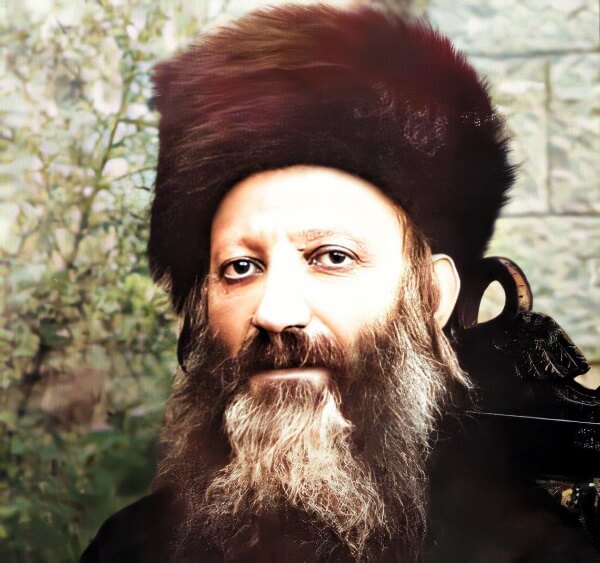
| 5625 (1865) | Born on the 16th of Elul, 5625 (Sep. 7, 1865) in Greive (now Griva), a suburb of Dvinsk in Latvia. |
|---|---|
| 5645 (1884) |
 At age 18, he studied for a year and a half at the famed Volozhin yeshiva.
 The head of the Volozhin yeshiva, Rabbi Naftali Tzvi Berlin (the "Netziv"), held the "ilui [prodigy] from Griva" in high esteem. Related article: Purim holiday in Volozhin |
| 5646 (1886) |
 Married Batsheva, the daughter of Rabbi Eliyahu David Rabinowitz-Teomim (1843-1905)
(known by his initials, the Aderet), then rabbi of Ponevezh, and later chief rabbi
of Jerusalem.
Married Batsheva, the daughter of Rabbi Eliyahu David Rabinowitz-Teomim (1843-1905)
(known by his initials, the Aderet), then rabbi of Ponevezh, and later chief rabbi
of Jerusalem. |
| 5648 (1888) |
 Appointed rabbi of Zeimel (Zeimelis) in Lithuania at age 22.
 Launched a short-lived monthly rabbinic journal, Itur Sofrim. |
| 5649 (1889) |
 During his stay in Zeimel, Rav Kook's first wife died.
(Their daughter Frayda Chana was a year and a half at the time.)
During his stay in Zeimel, Rav Kook's first wife died.
(Their daughter Frayda Chana was a year and a half at the time.)His father-in-law the Aderet convinced him to marry Raiza-Rivka Rabinowitz, daughter of the Aderet's twin brother. Raiza-Rivka was the mother of Rabbi Tzvi Yehuda Kook, Esther Ya’el Kook, and Batya-Miriam Ra'anan. Studied with the great Kabbalist, Rabbi Shlomo Elyashiv (1839-1926), author of Leshem Shevo Ve-Achlamah. |
| 5654-5656 (1894-1896) | Collected 38 sermons in the book Midbar Shur. The manuscript, however, was stolen, and the book was only published a century later, in 1999. |
| 5656 (1896) |
Became rabbi of Boisk (now Bauska), Latvia. Wrote Musar Avicha, a treatise on moral reflections (published posthumously in 1946). Related article: The story of the gold watch |
| 5664 (1904) |
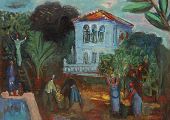 Arrived in Eretz Yisrael on the 28th of Iyar, 5664. He served as rabbi of
Jaffa and the surrounding settlements for the next ten years.
Arrived in Eretz Yisrael on the 28th of Iyar, 5664. He served as rabbi of
Jaffa and the surrounding settlements for the next ten years.Related articles: Rav Kook Arrives in Jaffa, The Blessing of a Kohen |
| 5665 (1905) |
 Published the first chapters of Orot HaTeshuvah, Rav Kook's
original thoughts on the topic of repentence, as well as Eder HaYakar and Ikvei Hatzon.
Published the first chapters of Orot HaTeshuvah, Rav Kook's
original thoughts on the topic of repentence, as well as Eder HaYakar and Ikvei Hatzon.
Related article: Overview of Orot HaTeshuvah |
| 5670 (1910) | Sabbatical year. Published the Halachic work, Shabbat Ha'Aretz,
in defense of the heter mechirah.
Related article: Explanation of permit to work the land during the Sabbatical year |
| 5674 (1913) |
Lead a mission of rabbis to settlements in the north to encourage them and
strengthen religious observance.
Related articles: Dances of Teshuvah in Poriah, A Wise Old Nation, Visit to Merchavya |
| 5674 (1914) |
 Traveled to Europe for Agudat Yisrael convention in Germany.
Unable to return to Eretz Yisrael due to the sudden outbreak of World War I, Rav Kook
spent a year and a half in St. Gallen, Switzerland.
Traveled to Europe for Agudat Yisrael convention in Germany.
Unable to return to Eretz Yisrael due to the sudden outbreak of World War I, Rav Kook
spent a year and a half in St. Gallen, Switzerland.
Related article: Rav Kook first meets Rabbi David Cohen, the 'Nazir' |
| 5676 (1916) |
 Served as rabbi of Machzikei HaDat congregation in
London for three years during the war. Published the mystical treatise Rosh Milin.
Served as rabbi of Machzikei HaDat congregation in
London for three years during the war. Published the mystical treatise Rosh Milin.
Related articles: The Balfour Declaration, "Fight On My Behalf" |
| 5679 (1919) |
 Returned to Eretz Yisrael.
In Tevet 5680, he accepted the position of Chief Rabbi of Jerusalem. Related article: The Jerusalem Policeman |
| 5680 (1920) |
 Rabbi Tzvi Yehuda Kook edited some of his father's writings,
publishing them in the book Orot - Rav Kook's most famous work.
Rabbi Tzvi Yehuda Kook edited some of his father's writings,
publishing them in the book Orot - Rav Kook's most famous work.
Related articles: The Printer's Dilemma |
| 5681 (1921) |
 Established Chief Rabbinate of pre-state Israel, becoming
Chief Rabbi together with Sephardic Chief Rabbi Yaakov Meir.
Established Chief Rabbinate of pre-state Israel, becoming
Chief Rabbi together with Sephardic Chief Rabbi Yaakov Meir.
Related articles: The Kosher Kitchen of the Poel Mizrachi, Blasts That Penetrate the Heart, The Kotel Affair |
| 5684 (1924) |
 Established the
Mercaz HaRav yeshivah in Jerusalem, unique among the yeshivot at that time in
its religious philosophy and positive attitude towards Zionism.
Established the
Mercaz HaRav yeshivah in Jerusalem, unique among the yeshivot at that time in
its religious philosophy and positive attitude towards Zionism. |
| 5695 (1935) |
 Rav Kook passed away in Jerusalem on the third of Elul, 5695,
two weeks before his 70th birthday.
Rav Kook passed away in Jerusalem on the third of Elul, 5695,
two weeks before his 70th birthday.
Related articles: Stay in the Land, Usishkin's Eulogy, Burial in the Mount of Olives Cemetery |